Engineering Ownership · Controlled Industrialization
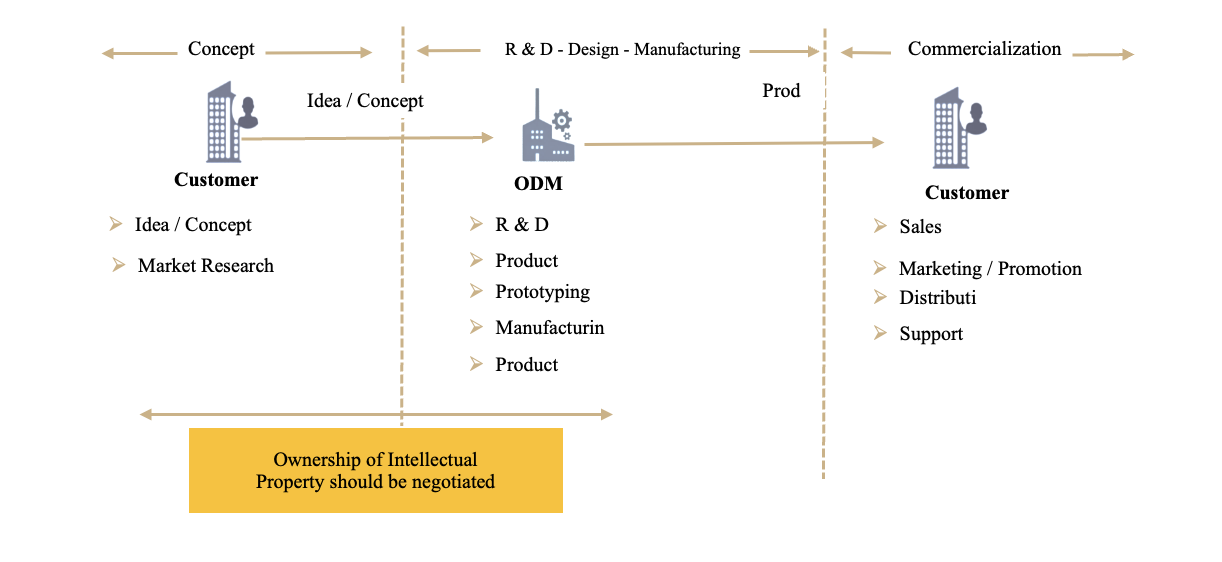
GEPVS provides ODM and JDM services through an engineering-led development and industrialization model, assuming technical ownership and delivery responsibility rather than offering isolated design or manufacturing support.
System Definition & Engineering Control
• Functional requirement clarification and system scope definition
• System architecture design and technology route selection
• Manufacturability, scalability, and lifecycle risk assessment
Engineering Development & Validation
• Hardware, firmware, and embedded software development
• Intelligent and AI-enabled system integration, where applicable
• Prototype, demo, and engineering sample development
• Functional testing, verification, and iterative optimization
Industrialization & Production Responsibility
• Design for Manufacturing (DFM) and Design for Assembly (DFA)
• Production documentation, test procedures, and quality standards
• Pilot build and controlled production ramp-up under ODM/JDM scope
• Supply chain coordination and manufacturing risk control
Deployment & Lifecycle Support
• System integration, commissioning, and start-up support
• Technical documentation and operator training
• Post-deployment technical support and performance optimization
Mass production is undertaken only where long-term system performance and engineering accountability can be effectively controlled.
PROCESS:Change according to different cooperation methods 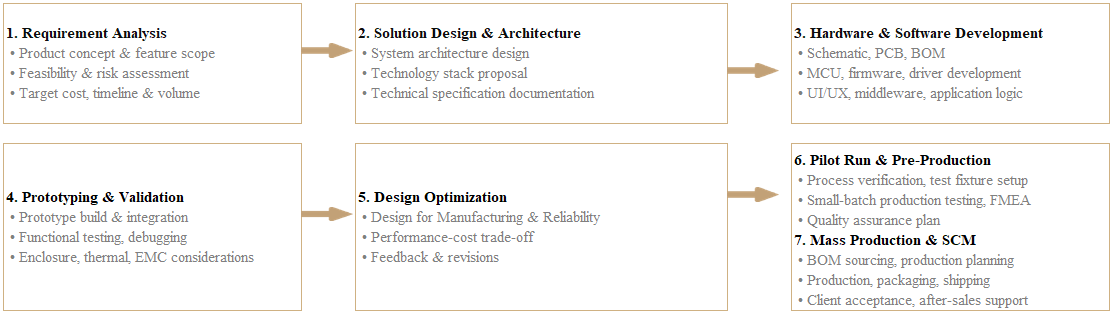
•Engineering-Oriented Multimodal AI Systems
Multimodal AI enables systems to process, correlate, and reason across multiple data sources, providing a higher level of reliability and decision quality than single-model approaches. GEPVS applies multimodal AI as a system-level engineering capability, embedded into hardware and software architectures for stable, long-term operation.
System-Level Value
In complex and data-intensive operating environments, multimodal AI delivers measurable system value by:
• Improving the accuracy and consistency of system state assessment through multi-source cross-validation
• Reducing false alarms and unnecessary manual intervention compared to single-sensor or single-model solutions
• Enhancing overall situational awareness under variable and uncertain operating conditions
• Enabling predictive insights to support operation planning, maintenance scheduling, and resource optimization
Technical Assessment Perspective
From an engineering and technical evaluation standpoint, multimodal AI provides:
• Greater robustness against individual sensor or data-source failures
• Improved adaptability to changing operating conditions through data fusion and model collaboration
• Scalable system architecture allowing additional data modalities and models to be integrated over time
• More verifiable and interpretable outputs through cross-modal correlation
Product Enhancement and Upgrade Value
At the product level, multimodal AI supports both new development and intelligent upgrading of existing systems:
• Conventional products can be upgraded into intelligent systems without fundamental hardware redesign
• Intelligent functions enhance product differentiation and market competitiveness
• Software- and model-driven upgrades extend product lifecycle and support long-term evolution
• Systems become better aligned with modern digitalization and intelligent-operation requirements
GEPVS supports multimodal AI systems across the full engineering lifecycle, from concept definition and system architecture, through prototype and demo validation, to controlled industrialization under ODM/JDM frameworks, deployment, and lifecycle support.
Multimodal AI is implemented as an embedded engineering capability, ensuring predictable performance, maintainability, and scalable growth.